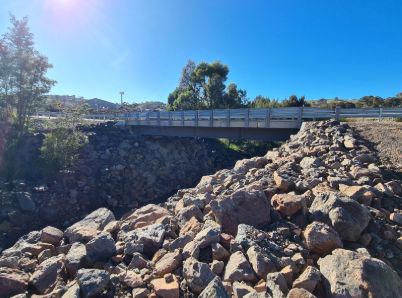
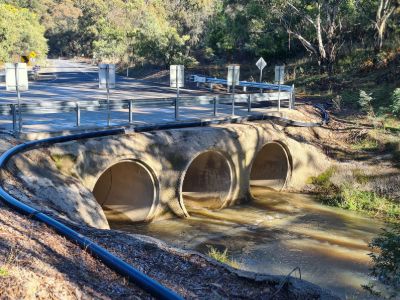
The purpose of the project was to confirm that the bridge and culvert could handle the high dynamic loads applied by various vehicle types. The client supplied load data for eleven different truck, trailer and dolly combinations. Each combination was analysed to understand how weight and movement affected the decks, girders, and supporting ground conditions.
Using Space Gass and Structural Toolkit, ARP engineers carried out detailed structural analysis for the concrete decks , steel girders and pile foundations of the bridge, and for the concrete deck and pipe system of the culvert. These tools allowed us to replicate real-world operating loads and confirm that all components performed as intended under the range of heavy vehicle scenarios.

The bridge measures 18.0 meters long and 9.3 meters wide. It includes a concrete deck supported by steel girder, lateral struts, and steel piles. Approach slabs at both ends are founded on compacted engineered fill. The deck rests on 6mm elastomeric bearing strips, with the primary girders anchored to the piles to ensure strength, stability and even load transfer.
The culvert structure is 36.6 m long and 13.68 m wide. It comprises a concrete pipe culvert with headwalls, wingwalls, and 4.2 m apron slabs at both ends. The concrete deck is supported by compacted embankment fill, while the main pipe culvert is embedded in foundation bedding to provide uniform load distribution.
The engineering analysis confirmed that both the bridge and culvert structures were capable of safely supporting the heavy vehicle loads in line with current Australian Standards. ARP’s work provided the client with verified assurance of structural integrity, enabling the continued safe operation of heavy haulage traffic across the site with confidence.


Victoria
Western Australia
Queensland
New South Wales
Tasmania
Australian Capital Territory
Northern Territory
South Australia