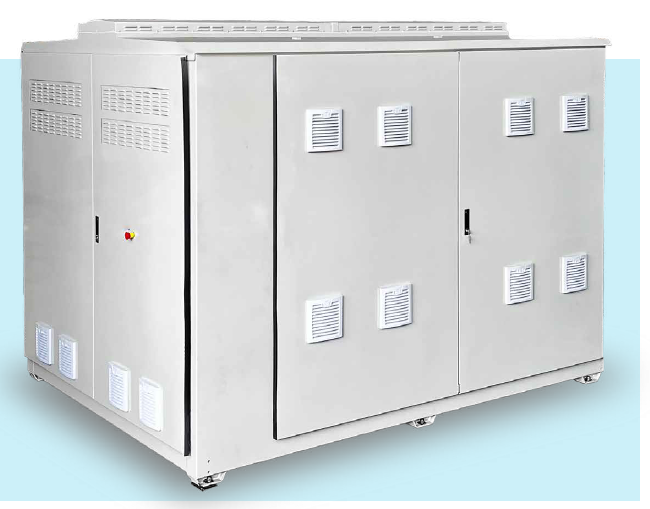
Our client approached ARP to review and verify the design of an enclosure for a new Battery Energy Storage System (BESS). The concept had been developed internally by the client, but required engineering validation to ensure safe lifting, handling, and transport.
This project involved Finite Element Analysis verification of the BESS enclosure carried out on SolidWorks engineering software.
The BESS enclosure was intended to be modular and easily transportable, allowing for deployment across multiple sites. ARP’s task was to confirm that the enclosure design could withstand lifting and transport loads safely, while also maintaining compliance with relevant Australian Standards.
Using our in-house finite element modelling capabilities, ARP’s mechanical engineering team created a detailed analysis model of the BESS skid and structure. The simulation assessed the enclosure’s response to lifting stresses, dynamic loads, and potential deflection during handling.
From this analysis, ARP was able to identify areas where material use and geometry could be optimised to improve strength and reduce weight. Adjustments to the design were recommended to enhance overall rigidity and ensure consistent performance under transport and installation conditions.
The final result was a modular, easy-to-transport enclosure that met all engineering and compliance requirements. The design was verified to the latest Australian Standards, giving our client confidence in both the safety and market readiness of their product. The project outcome demonstrated ARP’s ability to combine practical design insight with rigorous analysis, resulting in a reliable and innovative energy storage solution.